

Casa & Beyond
What Size Tablecloth Do You Need?
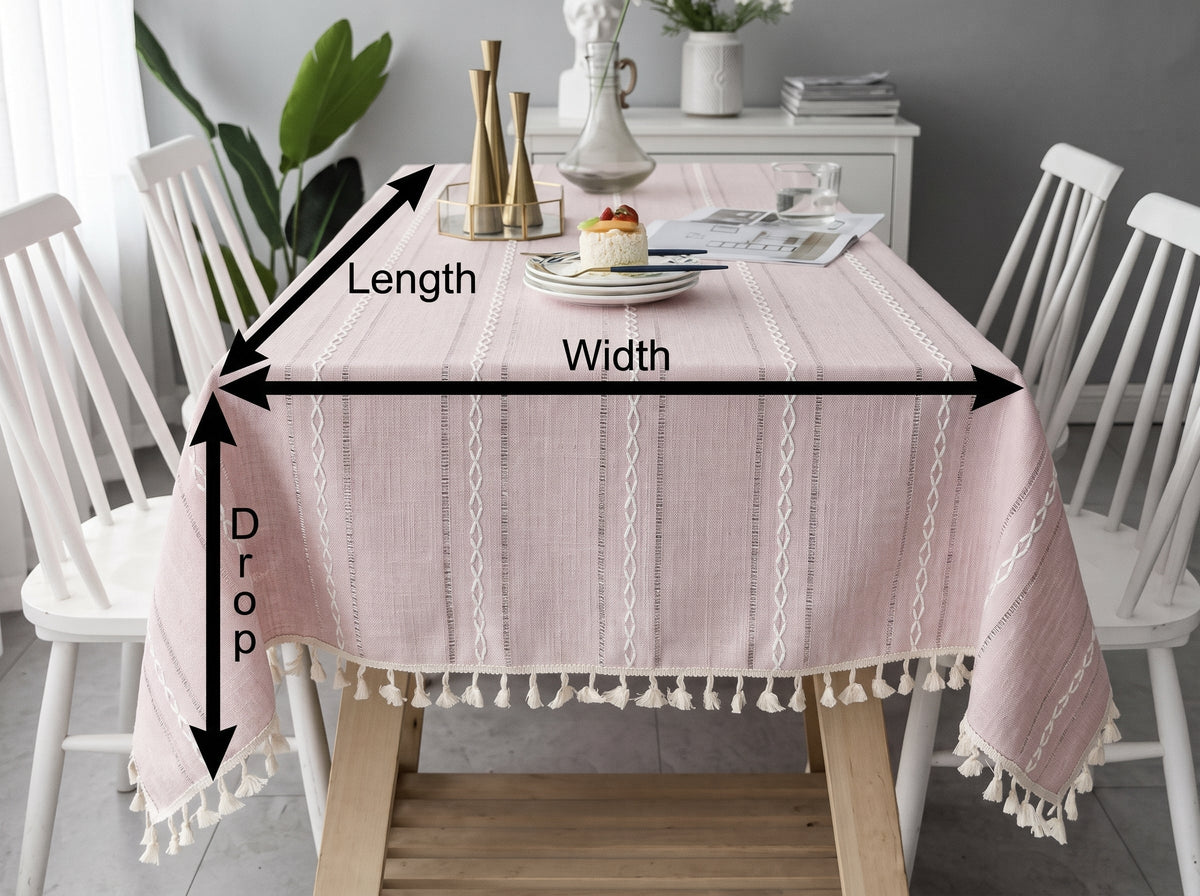
As a rule of thumb, the right tablecloth size is your table's length and width plus twice the drop you'd like on each side. For a standard drop of 25–30 cm (10–12 in), that means adding around 50–60 cm (20–24 in) to each measurement. A 90 x 180 cm (35 x 71 in) table, for example, usually suits a tablecloth of about 150 x 230 cm (59 x 91 in).
Tablecloth sizes are easy to get wrong because tables vary so much in shape and size. Below is a breakdown of the most common tablecloth sizes, how to measure your own table, and how much overhang tends to look right.
| Table Shape | Seats | Typical Table Size | Suggested Tablecloth Size |
|---|---|---|---|
| Rectangular | 4 | 90 × 120 cm (35 × 47 in) | 140 × 180 cm (55 × 71 in) |
| Rectangular | 6 | 90 × 180 cm (35 × 71 in) | 150 × 230 cm (59 × 91 in) |
| Rectangular | 8 | 100 × 220 cm (39 × 87 in) | 150 × 270 cm (59 × 106 in) |
| Square | 4 | 90 × 90 cm (35 × 35 in) | 140 × 140 cm (55 × 55 in) |
| Round | 4 | 90 cm (35 in) diameter | 150 cm (59 in) round |
| Round | 6 | 120 cm (47 in) diameter | 180 cm (71 in) round |
| Round | 8 | 150 cm (59 in) diameter | 210 cm (83 in) round |
| Oval | 6 | 90 × 180 cm (35 × 71 in) | 150 × 230 cm (59 × 91 in) |
What Size Tablecloth Do You Need? A Quick Answer
Tablecloths are sold in a handful of standard sizes, so most tables will fit one of them. The best match depends on the shape of your table and the drop you're after.
Rectangular Tables (4, 6 and 8 seats)
Rectangular tables are the most common, and their size is usually described by the number of seats. A 4-seater is typically around 90 x 120 cm (35 x 47 in) and suits a 140 x 180 cm (55 x 71 in) tablecloth. A 6-seater (around 90 x 180 cm / 35 x 71 in) generally needs 150 x 230 cm (59 x 91 in), and an 8-seater (around 100 x 220 cm / 39 x 87 in) pairs well with 150 x 270 cm (59 x 106 in).
Seat counts are only a guide. A narrow 6-seater and a wide 6-seater can differ by 20 cm (8 in) or more, so use the table above as a starting point and check it against your own measurements. A cloth that's too short at the ends is the most common rectangular mistake: the corners look bare, and the cloth slides off whenever someone leans on the table.
Square Tables
A square table generally suits a square tablecloth best. A 90 cm (35 in) table works with a 140 x 140 cm (55 x 55 in) cloth, while a 100 cm (39 in) table is better with 150 x 150 cm (59 x 59 in). Both give an even drop of about 25 cm (10 in) on every side.
For a more styled look, you can lay a square cloth diagonally so the corners hang down at the middle of each side. Keep in mind that this uses more fabric than a straight fit, so you'll need a larger tablecloth to achieve a similar drop. Before buying, check that the cloth is large enough to cover the tabletop diagonally while still leaving enough overhang on all sides.
Round Tables
Round tables follow the same formula: table diameter plus twice the drop. A 90 cm (35 in) round table suits a 150 cm (59 in) round cloth, a 120 cm (47 in) table suits 180 cm (71 in), and a 150 cm (59 in) table suits 210 cm (83 in).
A square cloth can also work on a round table, but the corners will hang much lower than the sides. If you go this way, choose a cloth at least as wide as the table's diameter plus 50 cm (20 in). The reverse is trickier: a round tablecloth on a square table often looks uneven, with a deep drop at the middle of each side and almost none at the corners.
Oval Tables
Oval tables use the same maths as rectangular ones: add twice the drop to both the length and the width. A 90 x 180 cm (35 x 71 in) oval table needs roughly 150 x 230 cm (59 x 91 in). An oval cloth gives the neatest finish, but a rectangular cloth of the same size works well too, with the corners draping softly over the curved ends.
Outdoor and Patio Tables
Outdoor tables tend to be larger, so a 150 x 270 cm (59 x 106 in) cloth is a common choice for 8-seater patio tables. A shorter drop of 15–20 cm (6–8 in) usually works better outside, because long overhangs catch the breeze and flap around. If your table sits in a windy spot, tablecloth clips or weights make a noticeable difference.
How to Choose the Right Tablecloth Size
Measure Your Table First
Measure the length and width of the tabletop from edge to edge. For a round table, measure across the widest point. If your table has a thick edge or an overhanging lip, include it in the measurement. Note the table height as well, as you'll need it if you're after a floor-length look.
Once you have the numbers, add the drop you want on every side and match the result to the nearest tablecloth size. If you land between two sizes, going up is usually easier than going down, since a few extra centimetres of overhang looks better than a cloth that's too short.
Decide How Much Drop You Want
Drop is the amount of fabric that hangs over the edge of the table. It has the biggest effect on how a tablecloth looks, and it's where most sizing mistakes happen.
| Style | Drop | Best For |
|---|---|---|
| Short | 15–20 cm (6–8 in) | Everyday meals, outdoor tables |
| Standard | 25–30 cm (10–12 in) | Most dining tables and family dinners |
| Formal | 40–45 cm (16–18 in) | Dinner parties and special occasions |
| Floor-length | Around 70 cm (28 in) | Weddings, banquets and buffet tables |
Too little drop is the mistake you'll notice first: the cloth slips off the edge, shows the tabletop and looks undersized. Too much drop is just as common. Fabric hanging past 45 cm (18 in) tends to get caught under chair legs, ends up in laps and is easy for kids or pets to pull. For a regular family table, 25–30 cm (10–12 in) is a safe place to start.
Match the Size to the Occasion
An everyday tablecloth can be a closer fit with a shorter drop, which keeps it out of the way and easy to wash. For a dinner party, a deeper drop of around 40 cm (16 in) gives the table a more polished look. Christmas lunch and other seasonal tables often need extra length, because leaves get added or a second table gets pushed alongside the first. Measure the full setup before you buy.
Allow for Extending Tables and Leaves
If your table extends, measure it both closed and fully extended. A cloth sized for the extended table will hang well past the ends when the leaves are out. If you only extend the table a few times a year, buy for the closed size and add a table runner or a second cloth on the bigger days. If you extend it regularly, size for the extended table and accept a deeper drop at the ends the rest of the time.
Think About Fabric and Shrinkage
Natural fabrics such as linen and cotton can shrink slightly after the first few washes, so a cloth that fits perfectly out of the packet may sit a little short afterwards. Check the care instructions and product details before buying, as some fabrics are pre-shrunk or treated to minimise shrinkage. If you're unsure, allowing a little extra room can help, but always follow the manufacturer's sizing and care recommendations.
Final Thoughts: Choosing the Right Tablecloth Size
A reliable way to find the right tablecloth size is to measure your table and add the drop you want on every side. A drop of 25–30 cm (10–12 in) suits most dining tables, while 40 cm (16 in) or more is better kept for formal settings. Seat counts and size labels are only a rough guide, so your own measurements are the better starting point.
Before you buy, check the exact dimensions on the product listing, allow a little extra for fabrics that shrink, and think about whether your table ever extends. A few minutes with a tape measure is usually all it takes to find a tablecloth that fits neatly.